


Latest Demo
Latest Demo
The demos I played, with what I think.
I play demos like regular review games: apart from the title and genre, I try not to know anything else, spoiler free!
When a game is officially released, the mini-review is deleted along with the video on YouTube :D
Past Demos
New Demo
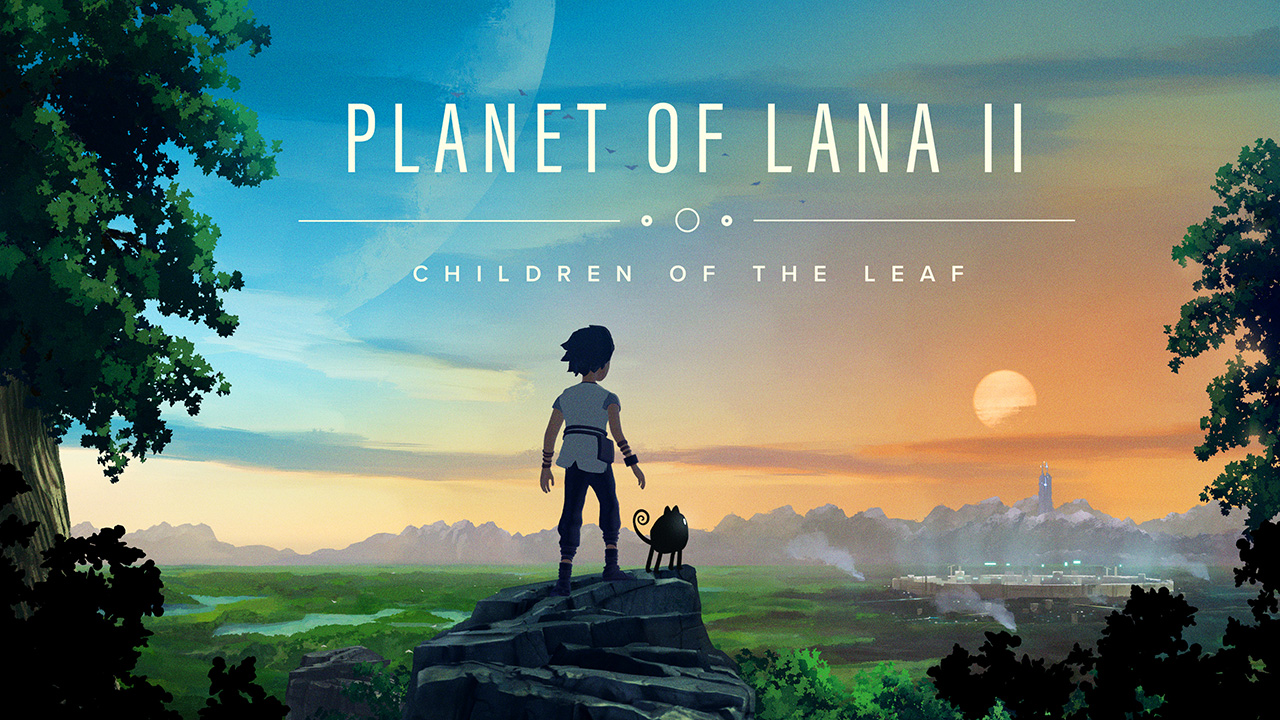
Planet of Lana: Children of the leaf
Mentre l’avarizia e il potere dividono le tribù del loro pianeta natale, Lana e il piccolo Mui affrontano insieme le forze che rimodellano il loro mondo, lottando non soltanto per la sopravvivenza, ma soprattutto per l’anima della loro terra. [da Steam]
Avventura, Rompicapo/Platform
Release Date: 5 Marzo 2026
Played
I played the demo a few days after its release.Completed in: a little over one hour (but I got stuck in a couple of places).
Review note: I own, but have NOT yet played the first chapter, so my knowledge of the plot and mechanics is partial. I only played the demo of the first game in February 2023.
Story
The demo doesn't tell us much about what the story of this sequel will be.
Considering only the demo, what can be gathered is that we obviously return to Novo, where we will see the human presence and the—seemingly—collusion with machines of certain groups. Here, Lana and Mui will face a new adventure, for themselves and for their planet.
Visual Style
Equal to or perhaps even superior to the previous chapter. Personally, I find it extraordinarily beautiful, among those “non-realistic”/low poly styles.The settings shown in the demo are incredible and fascinating, with vivid and vibrant colors, almost hypersaturated in some points, absolutely Ghibli-esque, to the point that the Japanese studio comes to mind even without knowing Wishfully's direct inspiration. And from what is shown in the demo, I have the impression that we will see many more environments, much more differentiated compared to the first chapter. This is only a good thing, because I strongly believe in its potential to build great worldbuilding, especially if this game isn't the final epilogue and the title becomes a series. Or even just a trilogy.
Game Mechanics
The demo practically focuses ONLY on what are presumed to be the new game mechanics.As base gameplay, we find the 2D side-scrolling puzzle-platformer, with an excellent alternation of platforming and “puzzles,” where we must stop to observe and reason about what is necessary to overcome obstacles and hindrances to move forward.
Basically, we see a new mechanic, or something close to it, for each of the 5 chapters shown in the preview. I’ll leave the explanation of each new mechanic below.
Chapter III: The Cure
The first innovation we see is Lana's ability to climb walls, both up and down, and jump from one to another if they are close enough, thus giving the levels the possibility to develop vertically without the need to jump across multiple platforms.
Here we also find surveillance cameras capable of detecting the presence of both Lana and Mui, which show no mercy: the moment this happens, in fact, they will kill them instantly without any chance for appeal or dodging. To counter them, we see the introduction of a new stealth mechanic based on hiding in the snow. In fact, we will find mounds of deeper snow, capable of hiding a crouching Lana, who can thus proceed without being noticed.
We also see humans patrolling, but for the moment they appear to be only in the background. They don't see us, they don't react in any way, and they aren't even on the same plane as the protagonists.
Last but not least, we also discover that Mui is no longer just a relatively secondary pet, but a creature with a special ability that expresses itself in various ways. The first of these, which we see in this first section of the demo, is “jamming” electronic devices, turning them off and forcing them into a restart that gives Lana time to bypass certain dangers.
Water Chapter (unnamed)
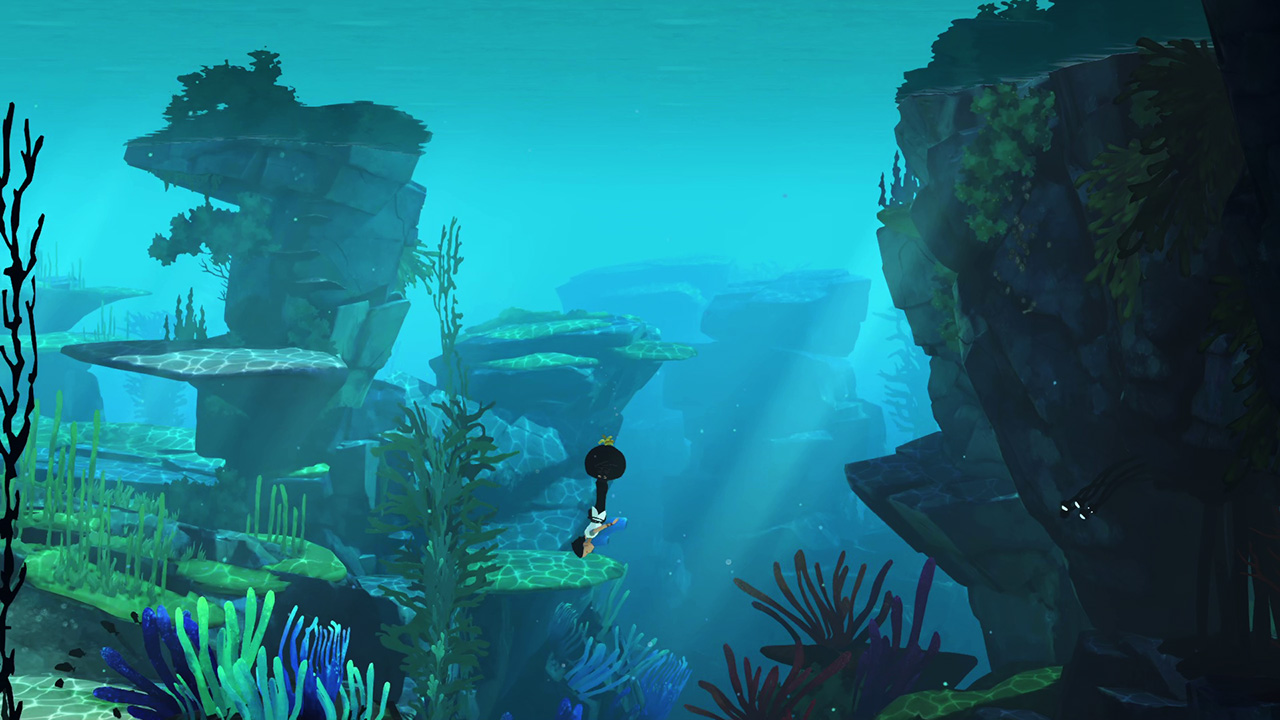
As an extreme lover of water in all its forms, I really appreciated the colors and the setting of this chapter. The crystal-clear water, the beautiful turquoise of the surface, the limitless horizon, and the tropical-looking coral reefs were truly refreshing in every sense of the word (more than the snow!).
Needless to say, this chapter revolves around swimming. Yes indeed, Lana not only swims, but can dive into the magnificent depths of the Novo seas where she will have to face long tunnels full of obstacles and somewhat aggressive fish.One of the most curious and well-thought-out things is that Mui can follow us through a very cute little worldbuilding trick, without this interfering with his ability to use his special skill even underwater.
Mui's ability underwater seems to be (at least) twofold: not only does he “fry” sea creatures (or plants?) that block entrances, but he can also mentally dominate other creatures, which we can then guide. It's not clear if he does a sort of override of their consciousness by imposing his own to remote-control them or if he "projects" himself strictly inside their head as if the body were his own, seeing through their eyes. Who knows if we'll find out!In any case, this opens up many new opportunities, not only because each creature provides different movement possibilities based on its size (very small creatures can pass through spaces where neither Lana nor Mui could) and its type (flying animals obviously... fly. Something that neither Lana nor Mui do natively), but it also forces us into additional mechanics that expand the puzzle part: having to identify these dominatable creatures, having to understand what ability they have, what it’s for, and what it can be applied to.
But how long can I stay underwater?? you might ask.
Yes, there is a mechanic related to the fact that you can't hold your breath forever, otherwise Lana drowns, but they simplified the matter by placing sponges that release bubbles from which you can draw the oxygen you need. Obviously, this keeps the mechanics realistic but at the same time not too complex. Planet of Lana is clearly a game that doesn't want to push the difficulty too far, it's not extreme, and this allows for calmly calculating the right timing and being able to restart from an underwater checkpoint without having to catch your breath first.
Forest Chapter (unnamed)
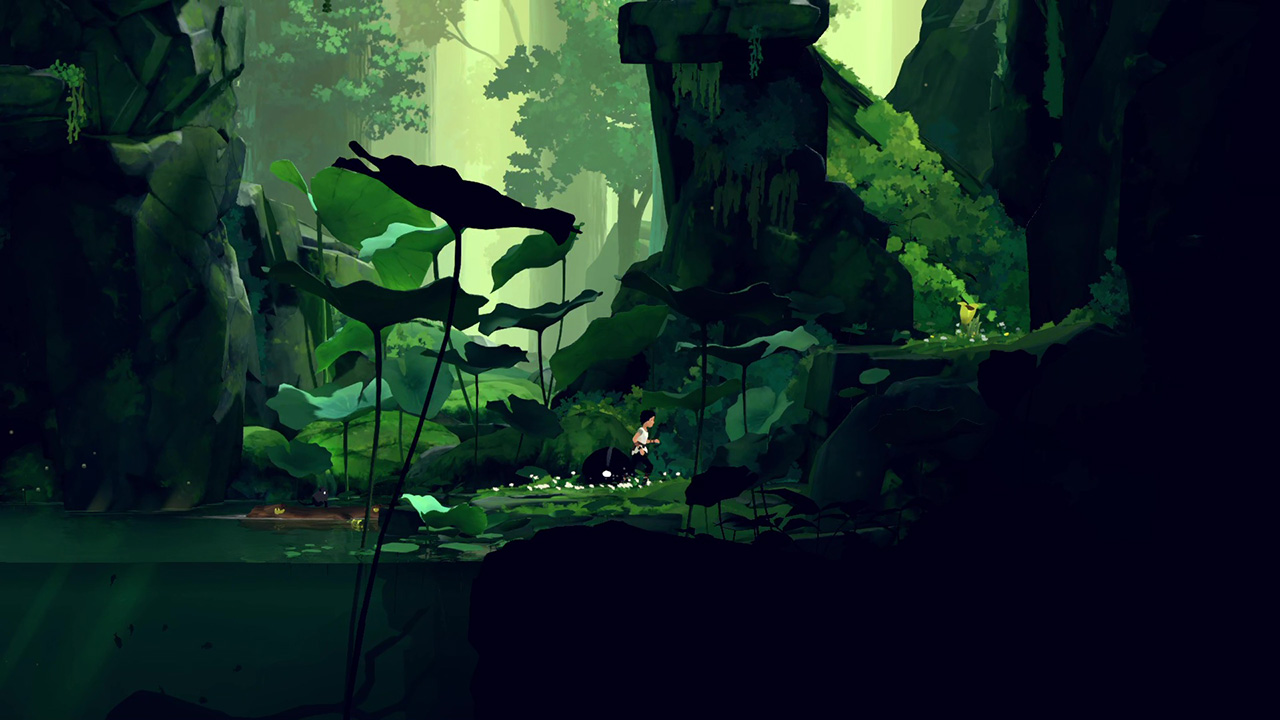
In this part, based on what is shown, we don't just see variations of things seen in other previews. The setting is beautiful here too, absolutely super Ghibli, and if I may offer a compliment, I LOVED the sounds of the big insect (if you haven't played the demo yet you'll understand me later, if you've already played it then you get me).
Chapter V: The Enemy
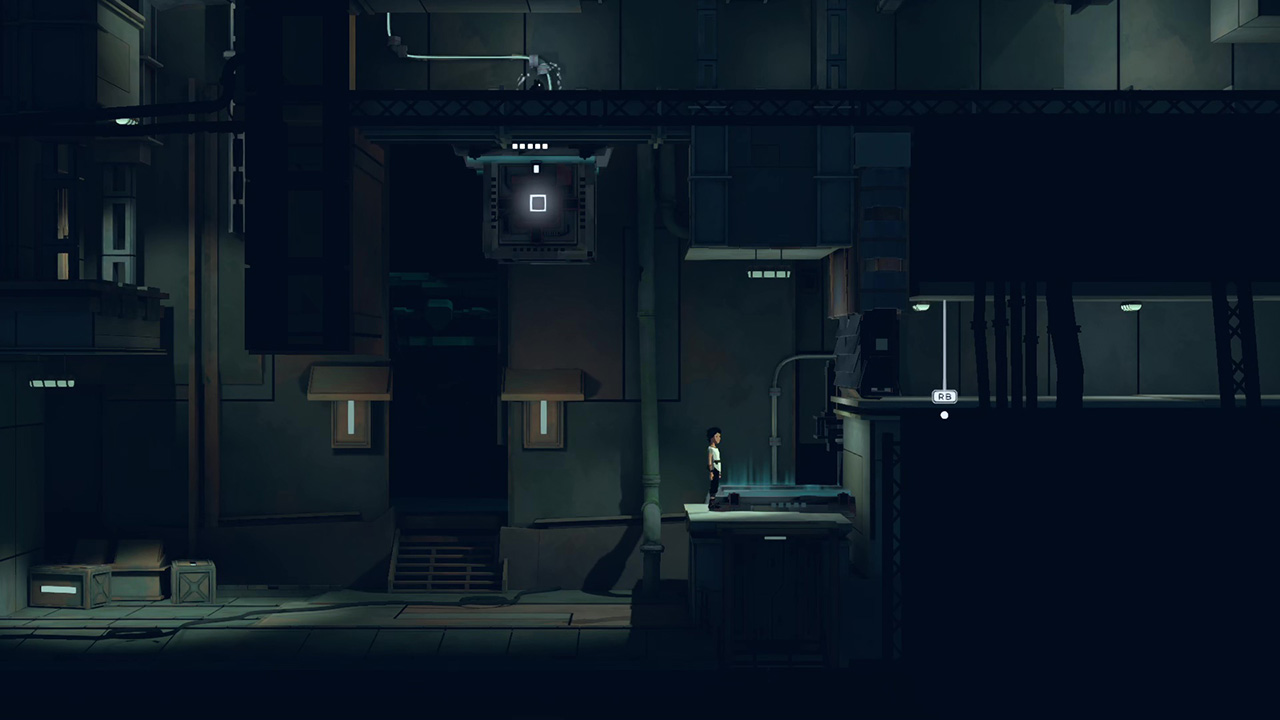
We find Lana and Mui again inside some laboratory, without knowing how they ended up there. From here they must escape and, in addition to Mui's ability to jam electronic devices, we see that Lana is also able to override some of these devices and take partial control of them, useful for making them move and directing them around.
My Thoughs
Even though I haven't yet played the first chapter at the time of writing, of which I did play the demo in 2023, I can say that this sequel inherits everything that was beautiful about Planet of Lana without losing anything, takes it and improves the slightly weaker points, such as the decidedly simpler gameplay in the first chapter.
In this sequel, Mui is no longer just a sort of cute pet, present more for lore reasons than actual mechanics, but a true companion to be used almost like a second player, transforming the game into a sort of “solo co-op,” where puzzle and platform are intertwined better than what was likely in the past.
La demo è davvero molto carina, dura circa 40 minuti-1 ora a seconda di quanto comoda ve la prendete e di quanto vi incastrate in certi punti e vedere nuovi ambienti di Novo e, come sembra almeno, insediamenti umani e tribù varie, ci porta più in profondità nella lore e nel worldbuilding.
Peccato solo non aver avuto alcuna spiegazione o sneak peek della storia nella demo 😀
So if you haven't played it, play it!

The Artisan of Glimmith
The Artisan of Glimmith is a cozy, relaxing puzzle game about coloring stained glass and restoring the artworks of a kingdom above the clouds. Explore a world of handcrafted puzzles designed with intent, where simple rules lead to delightful surprises. [From Steam]
Puzzle
Release Date: March 2026
Played
I discovered the game and its demo on BlueSky because someone was talking about it.
Completed in: about 2 hours and 45 minutes (played at night, calmly and with a certain tiredness).
Story
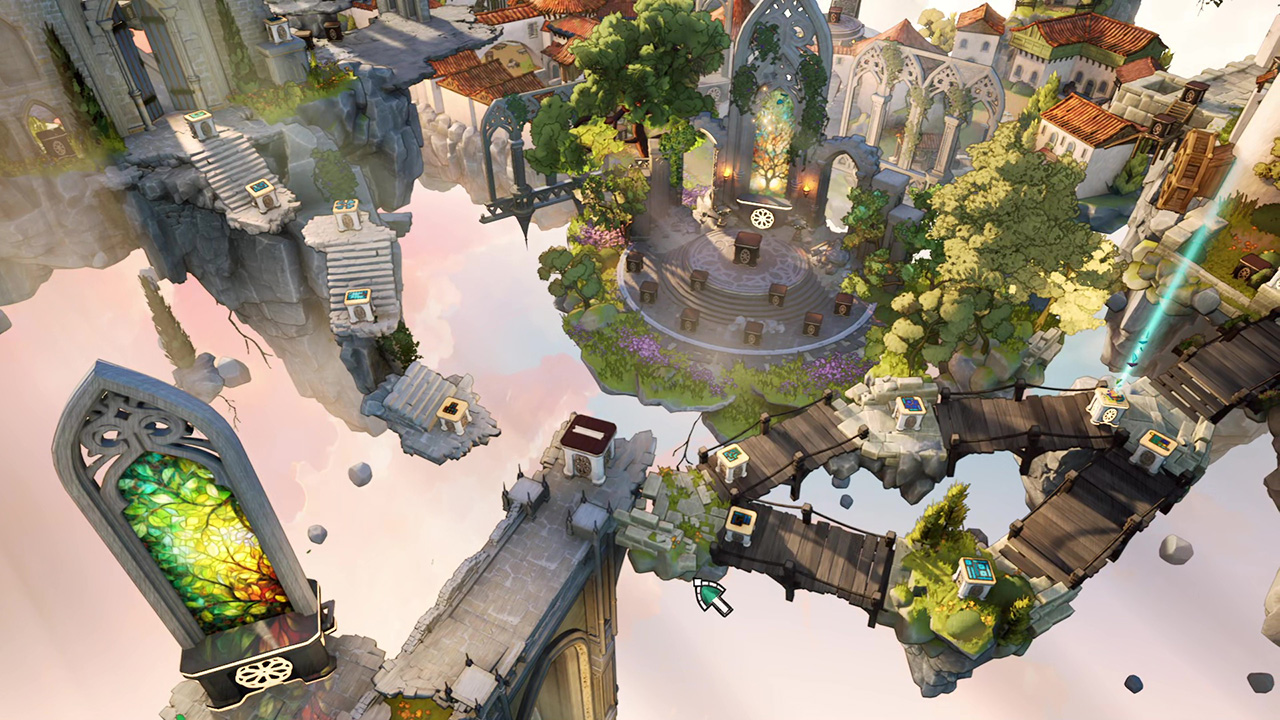
The plot seems to be minimal, as the game is very purely oriented towards puzzles. It is not an adventure and there is no other gameplay beyond solving puzzles. In practice, we arrive by flying ship in a kingdom suspended in the sky, where we are called to reconstruct and restore beautiful stained-glass windows which, at first glance, are very reminiscent of the pointed arches of Gothic basilicas. Except there is no basilica, only scattered ruins.
Or, at least, this is all that can be gathered from the demo.
We will have to see in the full game to know if more details will be added or not.
Honestly, even if it stayed this way, it wouldn't be a problem given the type of game. The presence or absence of a plot, other than explaining the reason for the setting, changes absolutely nothing.
Visual Style
The graphics are stunning to me.
The setting is well-developed, the colors are vibrant and well-thought-out, the 3D is polished and full of details emphasized by lights that give it an almost dreamlike quality, as if we weren't just suspended somewhere in the sky, but were actually in a metaphysical realm (and who knows, maybe it really is so?). I can't wait to see all the other areas when I get to play the full version in the future, because they must be beautiful!
At first, I found the isometric map annoying, I admit, because it seemed unnecessarily uncomfortable and limiting. Having the possibility to rotate, I won't say 360°, but with a good angle, sounded better. But then, playing and seeing that this was an excuse to hide some of the levels and that there was actually no need to see anything more than what was already possible to see this way, I got used to it and now I say it’s fine as it is.
Game Mechanics
Ah, il gameplay mi è piaciuto un sacco.
Non entrerò troppo nello specifico, perché altrimenti diventa una recensione vera e propria, quindi offro una rapida carrellata, anche se so già che finirò ad allungare il brodo :V
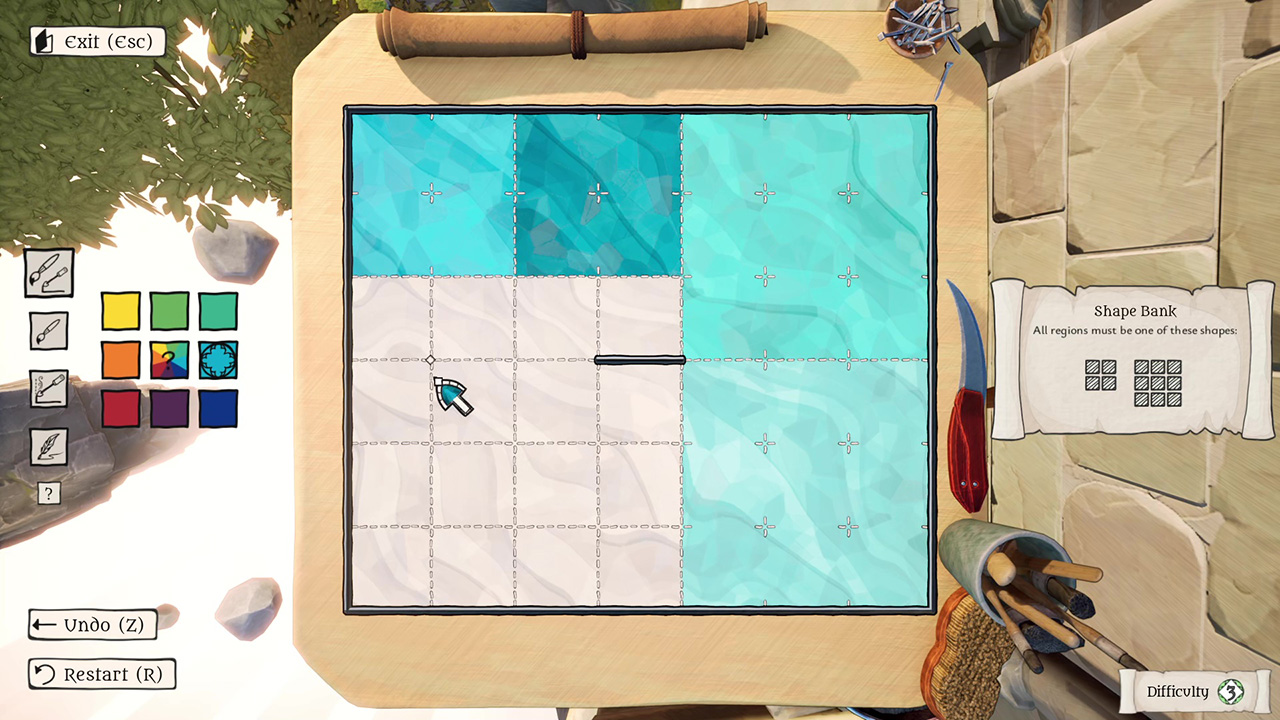
In the game, as Artisans, our mission is to restore the stained-glass windows we find around. Each window starts empty and fills with colored glass as we solve the puzzles connected to it, which vary in number.
There are two levels of completion: the first indicates the minimum levels to solve to proceed, the second allows for 100% completion, which is marked by the gilding that will appear on the frame.
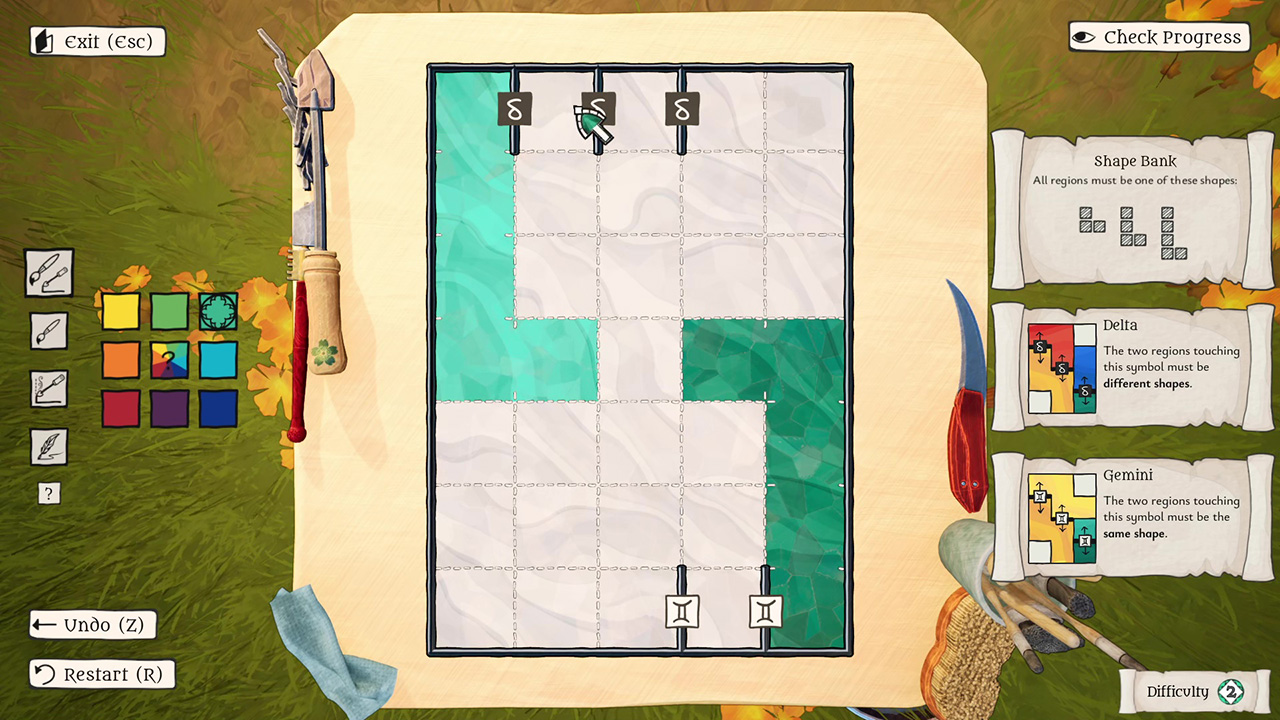
The puzzles are effectively logical riddles where, given a certain empty area, we must divide it into regions so that no empty spaces remain.
If it sounds easy put that way, there are a series of rules that complicate matters, for example: regions must or must not have a certain shape, or have an identical or different shape next to them, or perhaps their area must occupy a specific number of squares, etc. In the demo, if I remember correctly, there are about 10-12, while the full game should have 20.
Many of the puzzles and, arguably, a large part of the game as shown in the demo, work with tetrominoes, so it's all very geometric as well as logical. Each puzzle has a difficulty level ranging from 1 to 5. Note: levels with difficulty 5 are completely optional and are offered as a superior challenge for the hardcore fans!
The beauty of the game is also the artistic side offered to us: being glass artisans, obviously each level is presented as a small portion of a stained-glass window and here we can do things like decide what color each piece has, both during the resolution and after. To proceed to the next level, it is necessary to press a button. This adds a “cozy” component, where we can spend some time coloring after racking our brains.
Regions can be defined in two ways: either by coloring the squares directly or by delimiting their boundaries with lines that, in reality, represent the lead cames that hold the glass together. If you choose the latter solution, once the pattern is completed, the regions will all color automatically. Obviously, it's also possible to do a mix of the two things, coloring some regions and tracing lines for others.
It is also possible to both take notes, either on the edge of the level or within it if you want to plan ahead without using the game tools right away, and to return to every single level to change the colors.
Something that is super nice for those playing the demo is that in the full game, progress will be saved!
My Thoughs
Now, I must admit that I found the demo puzzles rather easy, BUT I don't say this in a negative sense for several reasons:
1) they are the first 52 levels, the difficulty grows progressively and having many levels of difficulty 1 and 2, with some tastes of 3 and 4 and a couple of 5s, allows for a stress-free learning curve, free to go back and forth through all the puzzles presented, start them, leave them halfway, and find your progress when you return (if I'm not mistaken, even between different sessions, if you exit and re-enter the game). At the same time, it provides a good idea of what the full game will be like.
2) the full game will be quite vast and we absolutely cannot know HOW difficult the puzzles will become, considering that there will be another 8-10 additional rules and that each puzzle can have well more than one (in the demo we see up to 3 at the same time, but there could be more!).
3) there is a “cozy” component, so even if the levels don't become more difficult than this, it's fine. Not everyone looks for an extreme challenge, not everything has to be a soul-like level but with puzzles. Not everyone is inclined the same way to solve puzzles, but everyone has the right to try playing riddles. So if it's a game that wants to offer challenges from easy to difficult but in a range where most people can engage and succeed in finishing it, it's more than welcome!
4) Just as I find puzzles that others find very easy extremely difficult, in this case, it could very well be the other way around. Even among us point-and-click, escape room, and general puzzle enthusiasts, not everyone likes the same things and we aren't all predisposed to find the same mechanics easy.
That said, the game is truly very beautiful and promises to remain just as interesting in its final version, with the right balance between effort and relaxation, where - I believe - most of the puzzles will be within reach for almost everyone, at least regarding the minimum goals to proceed. All the levels that remain beyond this can be easily solved one at a time, spending some time and attempts on them when you feel like it. The lack of an intense and structured plot actually helps us a lot in this regard, because it doesn't push our curiosity and desire to want to complete everything quickly just to "see how it ends".
Personally, I haven't had any kind of problem regarding bugs and glitches and everything went really smooth as silk.
I found it very fun and relaxing to be able to play with color combinations, as well as having the possibility to take notes or use only the "lead cames" to delimit certain regions without using colors! Being able to spend some time making a puzzle aesthetically pleasing after solving it is definitely a way to relieve tension.
Anche l’editor per creare puzzle, come altri giochi del genere (Portal e The Talos Principle Reawakened per citarne due un po’ più grossi), promette di allungare di molto la vita del gioco e dar modo alla community di creare ulteriori contenuti e anche eventi dedicati. Sarebbe carino, anche se non è la mia “cup of tea”, vedere una modalità “challenge” dov’è presente un cronometro per dimostrare quanto si impiega a risolvere i single puzzle. Insieme all’editor potrebbe dar vita a simpatici tornei 😀
PLAYTEST

Will: Follow The Light
Dive into a realistic, single-player, first-person journey through the harsh northern latitudes as you sail endless waters, searching for a way back to your loved ones. Will you follow the light? [From Steam]
Graphic Adventure, Puzzle
Release Date: 2026
Played
Discovered via X/Twitter and Steam, played on December 20, 2025Completed: about 1 hour, but taking the time to explore around beyond mere gameplay needs.
Story
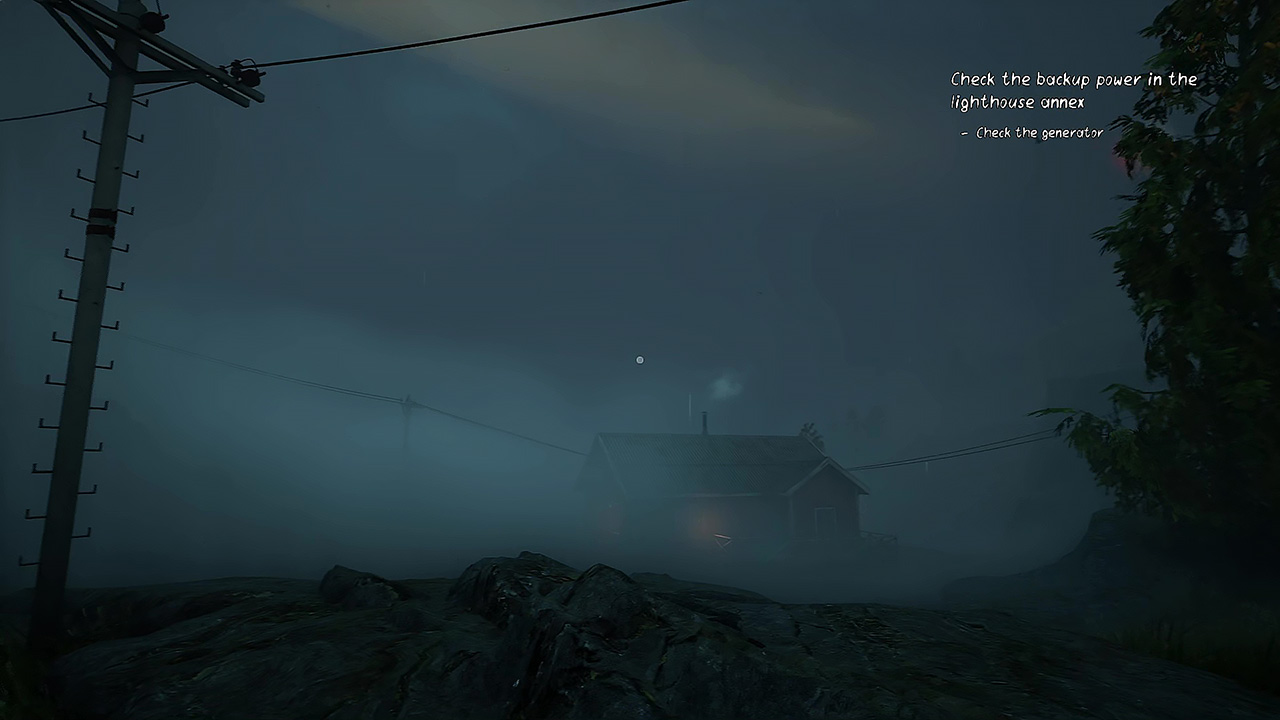
In the playtest, the plot is very limited to what we see, being the beginning of the game. There are elements that allow us to ask questions about the protagonist, but not to truly grasp the purpose of the story or what it tells as a whole. In the playtest, we meet Will, our somewhat grumpy protagonist, who, after an intense scene on a boat at the mercy of the ocean waves (or so it seems), we find taking care of the lighthouse in a remote, unspecified location (physically reminiscent of Scandinavian countries or the Scottish Highlands), where environmental and meteorological data are also collected. Will is alerted via radio by Cassandra (a character not yet fully explored, we only know she seems to live in the city), who warns him of a terrible storm arriving and assigns him various checking and maintenance tasks to prepare and activate the generator, ensuring the lighthouse doesn't go out.
Cassandra, among other things, confides in Will that his father is at her house, along with his son (I believe?) Thomas. This bothers Will, who lets us understand that there is no love lost between the two, as when he was a child, his father would lock him in the lighthouse to go drinking. To find out more, however, we have to turn to Steam. Here it is exp
To find out more, however, we have to turn to Steam. Here it's explained that Will's son has disappeared (or will disappear) and Will will set off aboard his boat, Molly, for an adventure through the harsh northern environments to find him, where at the same time we will delve into the relationship between him and his family and between him and his father, perhaps also on a journey of self-discovery.
Visual Style
Technically, the game is a first-person 3D, with a good degree of explorability around the areas of interest. I didn't directly test how wide the areas are, how far the map boundaries go, or if something specific happens when you get close to them or if there are only physical barriers to prevent us from going further (from the classic invisible wall to a rock face, from a forest that cannot be entered to the edge of a cliff, etc.). However, I did manage to look around the structures a little.
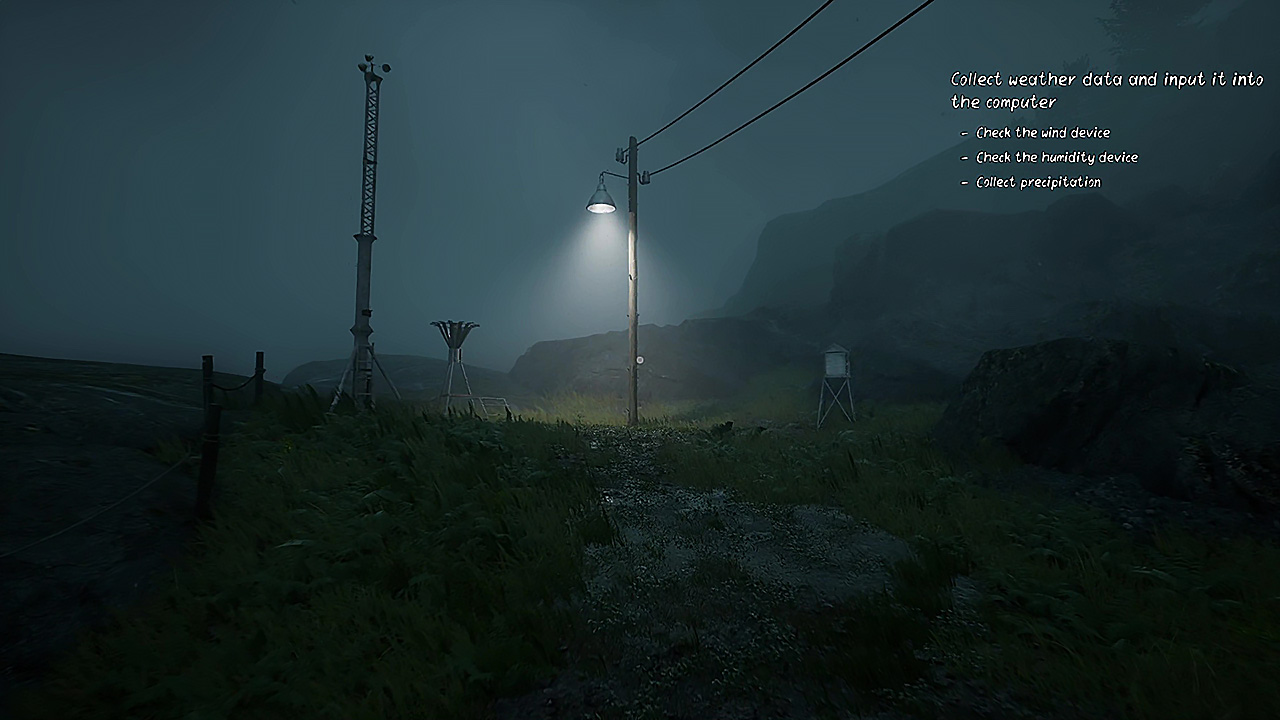
The entire setting we see in the playtest is entirely storm-themed: the scene at sea (flashback? nightmare? vision of the future?) is during a storm, all the rest of the checks and maintenance around the lighthouse are to prepare for the arrival of a storm; consequently, we go from a gray sky immersed in mist to the terrible purple gloom of the incoming gale. It is therefore not possible to evaluate the environments under sunlight and in the colors of spring. Only grayscale, mosses, and lichens. Only the red of the buildings saves us.
Despite this, however, the graphics are very pleasant, the landscapes already promise to be beautiful and well-reconstructed, realistic enough to appear as a modern game, without any attempt to adhere to some retro-gaming aesthetic as I've seen some titles do (Dimhaven below could be one of those, with its big pixels and graininess, perfect for that), but without trying to overdo it at the same time, especially in these times of RAM scarcity where we have to make do with the hardware we have, particularly with video cards (in my case, an RTX 2060 Gaming Z, already mounted for 5 years).
Game Mechanics
During the playtest, we don't see any original mechanics regarding the overall gameplay, and for now, they are limited to being similar to adventure and exploration simulation games in general (you walk, you go from point A to point B, you can study and use things marked by a dot to label them as interactive, etc.), except for the opening, where we start in the middle of a restless sea expanse, which is certainly an ocean, aboard a pleasure boat: a sailboat named Molly, with which we face the driving rain and the threatening swells of a storm. According to the trailer, it seems Molly will reappear at some point.
This is the most unique part offered for the playtest, and the attempt to make steering Molly realistic is interesting, with Will directing us using technical terms and us having to lower the mainsail and hoist the storm sail, as well as securing the boom to prevent everything from swinging (yes, yes, I had to take a dive into the rabbit hole of sailing terminology, scouring English and Italian sites, and I obviously got lost in it as if it were a closed mall during a zombie apocalypse). These mechanics, however, are limited to the initial part only.
Note: I saw that the supposed level of realism in the Molly scene sparked some criticism here and there, about it NOT being realistic enough and that many players passionate about sport sailing, or in possession of a nautical license, were not satisfied with the inaccuracies (see "My Thoughts").
Guardando il trailer a posteriori del playtest, è evidente che torneremo su Molly
For the rest, we have three other featured features:
1) the task indication, assigned to us via a log in the top right of the screen, capable of changing dynamically if there is another step to follow after completing something, which removes any need to guess the next step as in graphic adventures/point-and-click games;
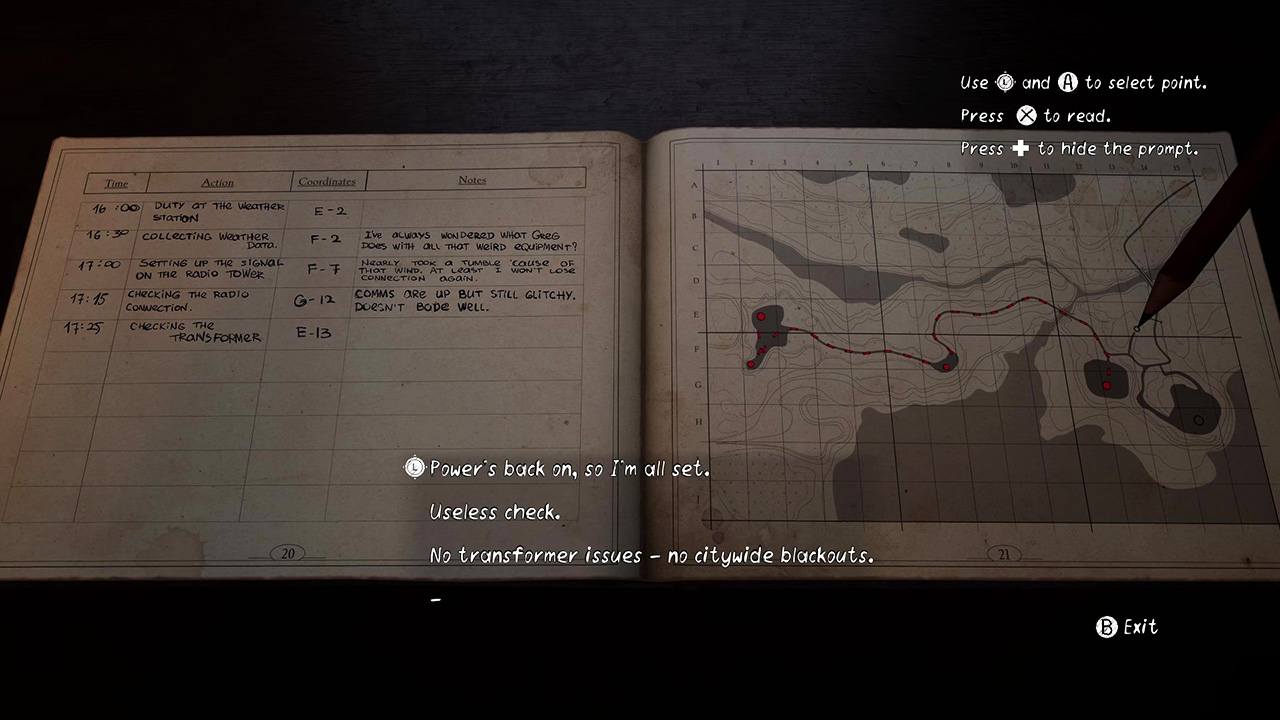
the very nice possibility of writing logs, registers, and reports when the game offers it;
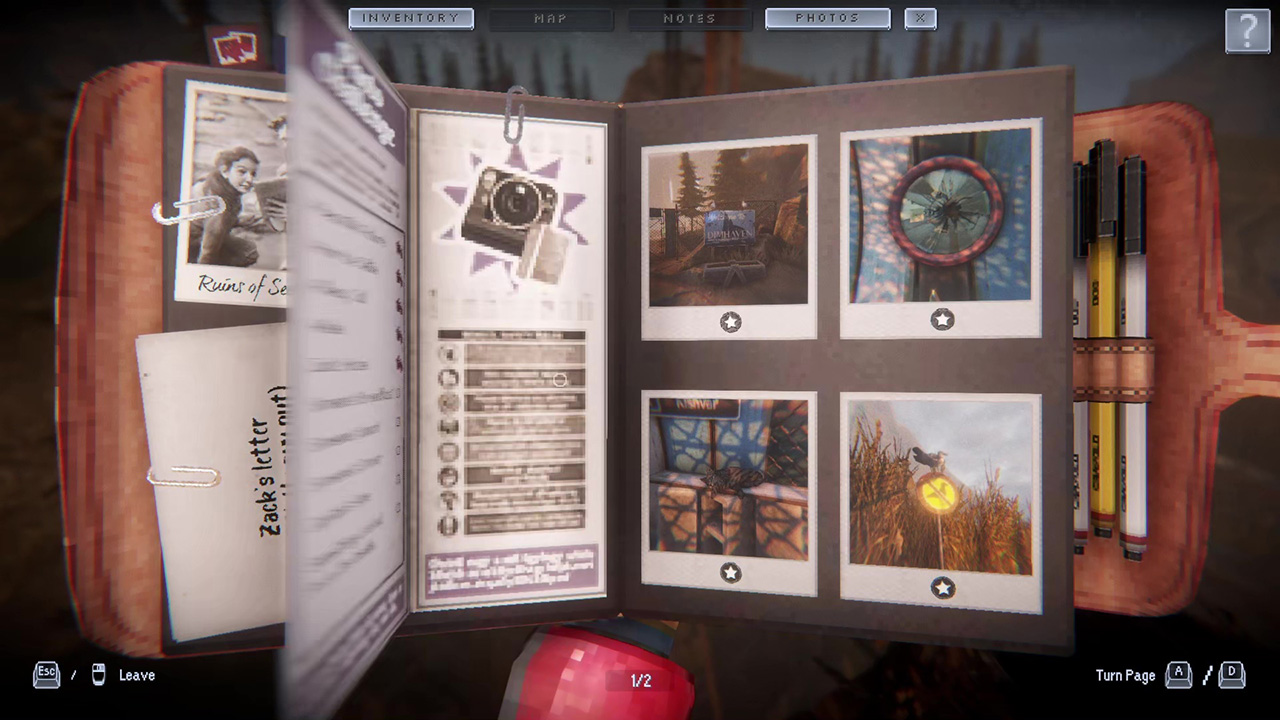
3) the presence of a diary where notes are automatically recorded—details and data collected at certain points to be entered elsewhere, without the need to write them down by hand (Dimhaven has also implemented a diary, but in their case, it is quite a bit more developed, with the possibility of taking photos and writing notes).
My Thoughs
The playtest already has the feel of a complete and well-made demo, but I can't say if the real demo will be this one or if it will be modified, and whether or not we will see it for the February Steam Next Fest, considering that the playtest ended in early January; the fact remains that for me it was very pleasant, the pace is well-set, the operations are simple to perform, and the places are intuitive to find. I didn't find—and I doubt there might be any in general—actual puzzles. The tasks are all quite plausible compared to reality, but we must take into account that this is an exploration simulator and not a graphic adventure.
Returning to the "realistic navigation" declared by the developers, as someone not passionate about sailing and ignorant on the subject, but who is with someone who, on the contrary, is an avid follower of regattas, I didn't feel this huge deficit; on the contrary, it really fascinated me. I found it engaging and it required me to extract information I didn't know, not being able to go look for it (no, I don't know anything when I start playing and I don't look for anything until I've finished), feeling the pressure of the heavy sea and the wind that risked overwhelming everything. It wasn't clear from the game if there was actually a possibility of failing the scene, or if it was just a kind of cutscene with a portion of interactivity; consequently, I put all my effort into it and even a few drops of rising anxiety.
So I had to learn on the fly that there are multiple ropes to, obviously, manage multiple sails.I had to learn that, obviously, the larger sail must be lowered so as not to fight with the wind.I had to learn that, obviously, having to move forward somehow, there are other sails to use, designed for different uses. Like the “storm jib” (a term I discovered later).And I also had to learn that, obviously, if the “boom” (boma, in Italian) isn't still, it risks launching you into the sea with an involuntary double pike (I only fully understood this dynamic later, because during the game I hadn't quite grasped what the “boom” was. It's the horizontal arm that holds the sail and connects to the mast and obviously, it swings. If it hits you because it's not well-secured, obviously, it throws you overboard).
Being this an adventure game and not the equivalent of Truck Simulator with vessels, one cannot expect that “realistic” equates to “hyper-realistic, a 1:1 faithful representation of everything involving navigation.” We will also have dog sleds to move across land at some point, and I hope one doesn't expect to have to feed the dogs, hitch and unhitch them one by one from the sled, or manage where they do their business (and don't get me wrong, in a “Sledging Simulator” that would be fantastic).
In short, as always, it takes a little common sense and, for me, that promise of “realistic navigation,” wherever I read it, is well-kept.

dimhaven: The Lost source
Are you ready for an adventure? Challenges, exploration and puzzles in a narrative driven experience, pick up your camera and test your wits in this first-person mystery by the team behind Quern! [From Steam]
Graphic Adventure, Puzzle
Release Date: Q2 2026
Played
Through Emily's eyes, we are parachuted (literally! D:) into the port of Dimhaven where, following a daring and truly unkind landing, we find ourselves on this island—once a small tourist paradise and now a strange place in ruins, apparently uninhabited. In the demo, we are not told what happened, but something did happen. We can feel it right from the initial dialogue on the plane with the lady. All we are allowed to know is that Emily is there to find out what happened to her uncle, a scholar who has lived on the island for a long time and of whom nothing more is known; this presents the story as a classic point-and-click: strongly narrative-driven, part investigation and part adventure, full of mysteries and peculiar events.
Story
Through Emily's eyes, we are parachuted (literally! D:) into the port of Dimhaven where, following a daring and truly unkind landing, we find ourselves on this island—once a small tourist paradise and now a strange place in ruins, apparently uninhabited. In the demo, we are not told what happened, but something did happen. We can feel it right from the initial dialogue on the plane with the lady. All we are allowed to know is that Emily is there to find out what happened to her uncle, a scholar who has lived on the island for a long time and of whom nothing more is known; this presents the story as a classic point-and-click: strongly narrative-driven, part investigation and part adventure, full of mysteries and peculiar events.
Visual Style
Well... the graphics cause a sort of mental dissociation that's hard to explain. On one hand, it feels like a modern 3D effortlessly wearing a tweed jacket, managing to look vintage without losing its freshness; on the other, it tickles that sense of familiarity that makes me believe I’ve just opened a point-and-click played fifteen or twenty years ago, or at most some remaster that improved the original title without distorting it, where the original atmosphere can still be found.
I don't know why, but this demo-opening reminded me for some reason of the atmosphere of Gabriel Knight 3: Blood of the Sacred, Blood of the Damned, perhaps the first real experience I had with point-and-click games and a title I loved madly. It intensely occupied a couple of months of my adolescence when I played it, I believe, in 1999 upon release? Or maybe in 2000. Somewhere around there.
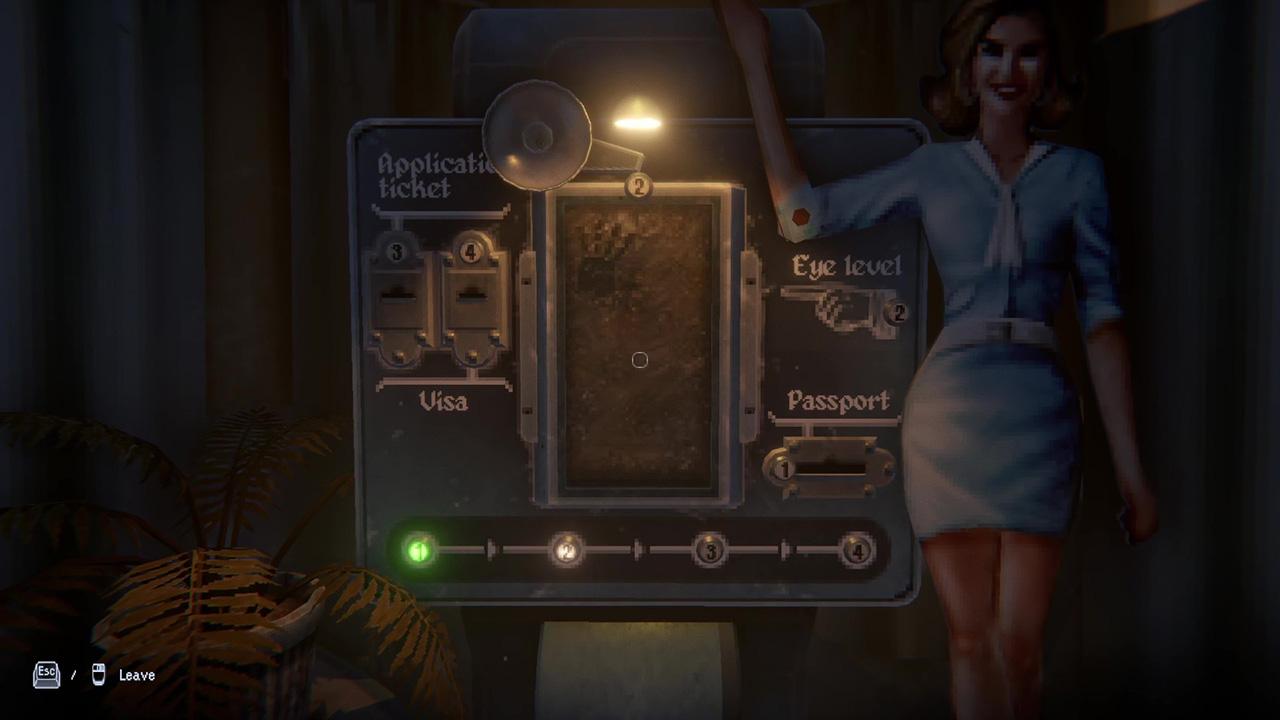
Even if it’s not my favorite setting, because I love the futuristic much more, the 80s vibes (even though, honestly, I would have sworn it was the 50s/60s, so much so that I thought of a diluted Fallout aesthetic) are very intriguing, particularly because we see an alternative version of them. Alternative in what way, with what differences? For now, we don't know. I liked them a lot, especially accompanied by the irony of certain details like the cardboard cutout of the lady at the automatic reception at the entrance, which glitches and jumps within exactly one minute. Or maybe less.
I think a lot of it comes from the pixelated graphics which, honestly, I admit I don't think is just an additional filter on normal 3D. If it is, hats off, because it's an effect that I unfortunately don't like and that I've been seeing a bit too often lately as "fake pixel art." I don't like it both because I find the result too sketchy and distant from real pixel art (which is something I try to avoid as much as I can anyway, perhaps I've had enough since most video games when I was a teenager were like that by necessity), and because it really triggers my motion sickness due to the way the pixels are clearly moving, something that doesn't happen in real pixel art graphics.
Che poi, a voler essere davvero precisi, parlare di pixelart è impreciso: Dimhaven ha una grafica che ricorda le basse risoluzioni, cosa significativamente diversa. ~Ai miei tempi~ questo tipo di grafica poteva essere benissimo all’ultimo grido in fatto di realismo e quello che reputiamo ora bassa risoluzione è tutto ciò che all’epoca si poteva raggiungere. Facile bistrattarla ora insomma 😀
Despite this, it is very clean and clear; everything is legible and well-defined, and until you get really close to objects, structures, and the like, the pixelated effect is even hard to notice. We'll have to see how the final game turns out, especially if it involves the presence of other people (something I'm very unaccustomed to, since with non-cartoon graphics I've only played extremely solitary first-person titles like Quern, Myst, The Witness, or The Room and other escape rooms).
Game Mechanics
I could easily describe them as "old but evergreen," because the demo left me with the exact taste of old point-and-click games, whether it's the atmosphere, the opening, the new-but-somewhat-retro graphics, or because the studio is the same as Quern (which, almost ten years after its release, I played in 2025 and whose review is waiting for me to publish it...).
So let's say that, at the core, we find the classic mechanics and dynamics: you go around poking your nose everywhere, clicking on anything that seems important first, anything that seems interesting later, and then clicking on anything that appears even vaguely interactive. In practice, you try to accumulate every sort of clue, object, and note you can find. This is both to advance the adventure, obviously, and to discover any hidden or rare achievements.
I really appreciated the high quality of the puzzles which, on a couple of occasions, brought me dangerously close to looking for a walkthrough, because they made me get stuck, albeit for different reasons: once it was the type of riddle itself, which required putting together multiple data points recovered from different places, and the other was simply due to a lapse in concentration where I missed a detail, and this prevented me from fully understanding what I had to do.
Due feature che personalmente non avevo ancora visto e reputo ormai caratteristiche del titolo (e mi scuso quindi se qualche gioco ce le ha simili, o non lo ricordo o non mi ci sono ancora imbattuto!) sono:
1) il diario che ci aiuta a raccogliere ed organizzare informazioni e le foto fatte, prendere appunti (ADORO quando nei giochi posso scrivere note, soprattutto se rimangono scritte a tempo indefinito e sono recuperabili!);
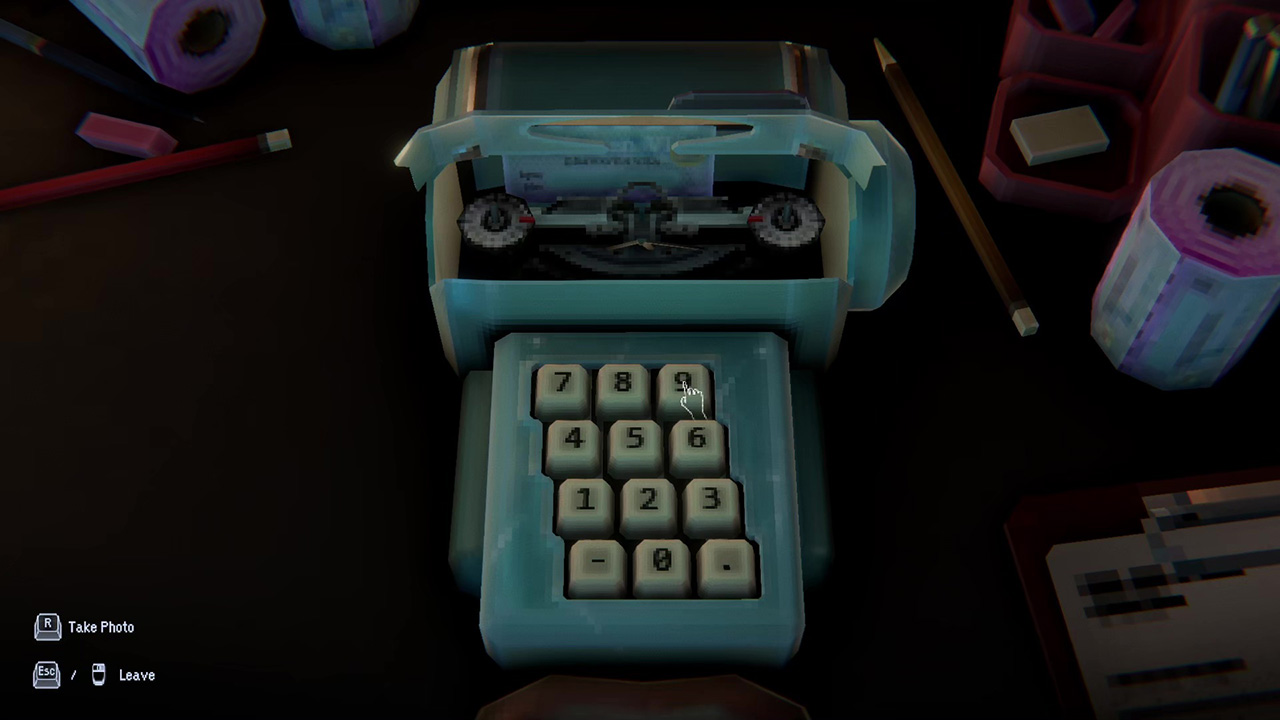
2) the camera through which we can take photos for the photo challenge, but not only (for example, I used photos for numbers, words, and so on, which were needed to solve other things perhaps physically at a distance, without having to write them down in my faithful notebook as usual).
I find these to be two really immersive additions story-wise and equally useful puzzle-wise, given the amount of detail we find and the nature of the riddles presented to us.
The only vaguely similar thing I remember in a game I've played directly is in A Space for the Unbound, where there is always a notebook that helps us navigate through quests, maps, objectives, and similar things.
There is also the very interesting “photo challenge,” in which we receive a list of clues that we must understand, corresponding to as many photos of specific views or details that we must find [you can find the video with the complete solution of the demo AND all the photos of the challenge HERE !].
My Thoughs
Personally, I liked the demo a whole lot. A WHOLE LOTTH.
The vibe is definitely very similar to the classics of the genre, from which it also draws direct inspiration by the developers' own admission, such as the Syberia and Myst series. After all, as already mentioned, these are the Quern people. I found the setting original even if it's not a "100% never seen before" (but on one hand, we know that with the tens of thousands of titles released in general, it's not easy to always invent something from scratch, and on the other, that even if a title isn't original in every single molecule, it doesn't mean it's not worth playing).
The 80s aesthetic, however alternative (and I repeat, I was convinced it was the 50s/60s), the seemingly abandoned island yet with traces of recent presence (or so it seems), all these tourist resort structures with notes and food remains still there, create a romantic urbex atmosphere that makes you want to poke your nose around every corner and inside every compartment, look under every stone, open every cabinet door. At the same time, however, the construction of the mystery that led Emily to want to reach Dimhaven and investigate her uncle's inexplicable disappearance is well-executed; this eerie aura given by the abandonment and the desert around us while we rummage through watchtowers, offices, and storage rooms tightens its long fingers ever stronger around our throat.
It’s that mix that at some point makes you wonder if there will be a jumpscare there, somewhere, unexpected for this type of adventure (classic first-person solitary point-and-click), which obviously there isn't.
I found the puzzles very well-conceived, fun to solve, and a great challenge in certain points, precisely because the solution might require dealing with other problems, finding objects, drawing conclusions, and only then putting together what remains in your hands to get to where you need to be.
The game really shows promise and it is obviously a demo I recommend everyone try if they get the chance!
Past Demos
Past Demos
Here you can find all the demos I played at past Steam Next Fests and in general, whose full game has not yet been released.
No demos available at the moment

